One fragrance gets compliments the moment you walk into a room. Another stays close, wears beautifully for hours, and feels almost personal. That is the real difference in perfume oils versus sprays - not which one is better in absolute terms, but how each format behaves on skin, in the air, and through the day.
For fragrance lovers building a wardrobe rather than buying a single bottle, format matters as much as scent family. A warm oud in oil can feel rich, intimate, and steady. The same profile in a spray may open brighter, project farther, and create a more immediate presence. If you wear fragrance for work, evenings out, gifting, or layering, the choice shapes the full experience.
Perfume oils versus sprays: the core difference
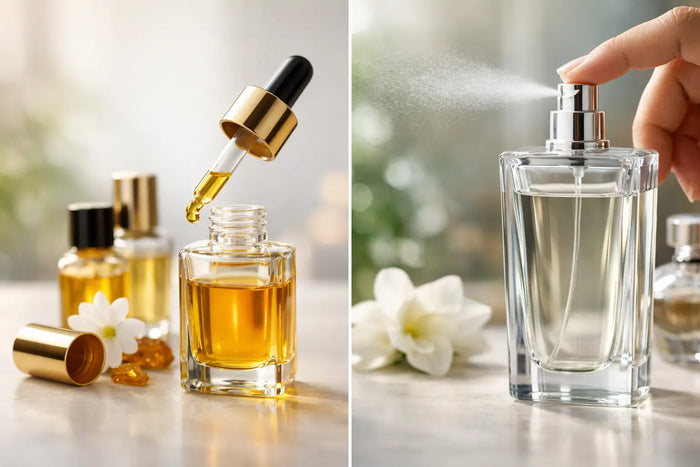
At the simplest level, perfume oils are fragrance concentrates carried in oil, while sprays use alcohol as the main carrier. That one formulation difference changes almost everything about performance.
Sprays tend to lift off the skin faster. You notice the opening immediately - the citrus feels sharper, florals bloom quickly, spices sparkle, and woods can arrive with more air around them. This is why many designer and modern niche perfumes feel expressive right away in spray form.
Perfume oils behave more gradually. They sit closer to the skin, unfold with warmth, and often emphasize the heart and base more than the sparkling top. On skin, that can make musks feel creamier, ambers smoother, and ouds more rounded. If you enjoy fragrance as a personal aura rather than a room-filling statement, oils usually deliver that effect better.
Neither format is automatically more luxurious. The luxury is in the composition, the raw materials, and how well the format suits the way you wear fragrance.
How sprays perform on skin and in the air
Sprays are built for diffusion. Alcohol evaporates quickly, helping the scent radiate. That makes sprays especially appealing when you want projection, a noticeable trail, or a fragrance that feels more animated in the first few hours.
This matters for daytime wear, social occasions, and settings where first impression counts. Fresh citrus, aromatic woods, clean musks, and modern florals often shine as sprays because their brightness is part of the appeal. If you want a scent to announce itself politely but clearly, a spray usually has the advantage.
Sprays also tend to present a fragrance in stages. You get the opening, then the heart, then the dry down with more contrast between them. Many fragrance enthusiasts enjoy that journey. A good spray can feel dynamic, with each hour revealing a different side.
The trade-off is that sprays can fade faster on dry skin, in air-conditioned spaces, or in very hot weather. They can also be easier to overapply. Two extra sprays of a heavy tobacco, saffron, or oud composition can shift a scent from elegant to overwhelming quickly.
How perfume oils wear through the day
Perfume oils are often chosen for longevity and intimacy. Because they do not rely on alcohol to disperse, they cling to the skin in a quieter, more controlled way. That often means less dramatic projection, but steadier wear.
On richer scent profiles - oud, amber, rose, musk, sandalwood, vanilla, incense - oils can feel especially beautiful. They soften edges and create depth. Some wearers find that oils smell smoother and more natural on skin, particularly if alcohol-based perfumes feel sharp at the start.
This makes oils a strong choice for close-contact settings, prayer-friendly routines, evening wear, and anyone who prefers fragrance that is discovered rather than broadcast. In many Middle Eastern fragrance traditions, that closeness is part of the appeal. The scent becomes part of your presence, not just something around you.
Still, oils are not perfect for every situation. If you love a sparkling opening or want your fragrance to project across a room, oils may feel too subtle. Some fresh profiles also lose a little of their lift in oil format. A crisp bergamot or watery floral often feels more vivid as a spray.
Perfume oils versus sprays for longevity
This is where shoppers often expect a simple winner, but the answer depends on what you mean by long-lasting. If you mean a scent remains detectable on skin for many hours, perfume oils often perform extremely well. Their close-to-skin nature helps them linger.
If you mean a scent stays noticeable to other people around you, sprays may seem stronger for the first part of wear because they project more. A spray can feel more powerful at hour one, while an oil may still be quietly present at hour eight.
Skin chemistry matters too. Oily skin often holds fragrance better than very dry skin. Climate also changes the result. In warmer weather, both oils and sprays can become more expressive, though sprays may evaporate faster while oils can grow richer with body heat.
So if your priority is all-day personal wear, oils are compelling. If your priority is noticeable projection during a dinner, event, or workday entrance, sprays often make more sense.
Which format gives better value?
Value is not only about bottle size or price per milliliter. It is about how much you use and what result you expect.
Perfume oils are usually applied in smaller amounts. A few dabs can be enough, especially with dense oriental, woody, or musky compositions. That can make a small bottle last surprisingly long. Oils also reduce waste from overspraying, which matters if you rotate through multiple scents.
Sprays offer convenience and speed. They are easier to apply evenly, easier to refresh during the day, and often more familiar for gifting. For many shoppers, that practicality is part of the value. If someone wants a versatile, easy-to-wear fragrance format with a clear scent arc, a spray is often the safer buy.
For collection building, the smartest approach is usually not choosing one forever. It is choosing by scent style and use case.
When to choose perfume oil
Perfume oil is a strong fit when you want warmth, depth, and a refined skin scent effect. It suits evening wear, intimate settings, prayer-conscious routines, and fragrance profiles built around oud, musk, amber, rose, sandalwood, and resinous notes.
It is also a smart option if you enjoy layering. Many fragrance lovers apply an oil first, then add a matching or complementary spray on top. That can boost longevity while giving the scent more projection and dimension.
Oil can also be kinder for people who dislike the alcoholic burst at the start of some sprays. If you want the heart of a fragrance with less sharpness, oil is often more comfortable.
When to choose a spray
Choose a spray when you want reach, lift, and easy application. It works well for office wear, daytime freshness, gifting, travel atomizers, and scent families that depend on a bright top note - citrus, fruity florals, aromatic fougere styles, fresh woods, and many modern unisex compositions.
Sprays also make comparison easier when you are exploring brands and profiles. Because the opening is so immediate, you can quickly understand a scent's style. For shoppers browsing curated fragrance selections, that speed can be useful.
If your wardrobe includes both classic designer perfumes and Arabic-inspired compositions, sprays are often the most flexible bridge between the two. They feel familiar, but still allow room for bold notes like saffron, leather, incense, and oud.
The best choice depends on your fragrance wardrobe
A single signature scent is one way to shop. A smart wardrobe is another. If you wear fragrance according to mood, season, or occasion, perfume oils versus sprays becomes less of a contest and more of a strategy.
For work, you may want a polished spray with clean projection. For evenings, an oil with amber, oud, or musk may feel more luxurious and more memorable up close. For gifting, sprays are often the easier choice because they suit a wider range of habits. For personal indulgence, oils can feel more distinctive.
Many experienced fragrance buyers eventually keep both. They use sprays when they want presence and oils when they want depth. They layer when they want the best of both.
That balanced approach is especially useful if you shop across multiple fragrance families instead of staying in one lane. A sparkling citrus floral, a soft powdery musk, and a deep smoky oud do not all need to live in the same format.
The better question is not which format wins. It is which one lets the fragrance perform the way you want it to. Once you understand that, shopping becomes much more precise - and much more satisfying.